
How Chinese Students Get a WES Evaluation
WES (World Education Services) is North America's most widely used third-party credential evaluator. It verifies your transcripts and degree, then converts them into US / Canadian degree and GPA equivalents that schools, employers and immigration authorities trust. To get a GPA, you usually need a Course-by-Course report.
Below we walk through what it is, which report to pick, the 5-step process, how to send documents, cost and timeline, and how WES turns your grades into a GPA — then help you decide whether you actually need it. Cost and timeline come from wes.org; some end-to-end figures are combined estimates that shift year to year, so check the current page before you pay.
Last updated · 2026-08-04 · AI Study-Abroad Report editorial team
Quick answer
- Do you need it: only when a target school, employer or immigration authority requires it; domestic Chinese grad admissions don't.
- Which report: pick Course-by-Course (CxC) if you need a GPA; Document-by-Document (DxD) if you only need degree equivalency.
- Time / cost: CxC takes about 2 weeks, with roughly 2 more for verification; end-to-end estimate 4–7 weeks; low hundreds of USD, per wes.org.
What WES is, and why schools ask for it
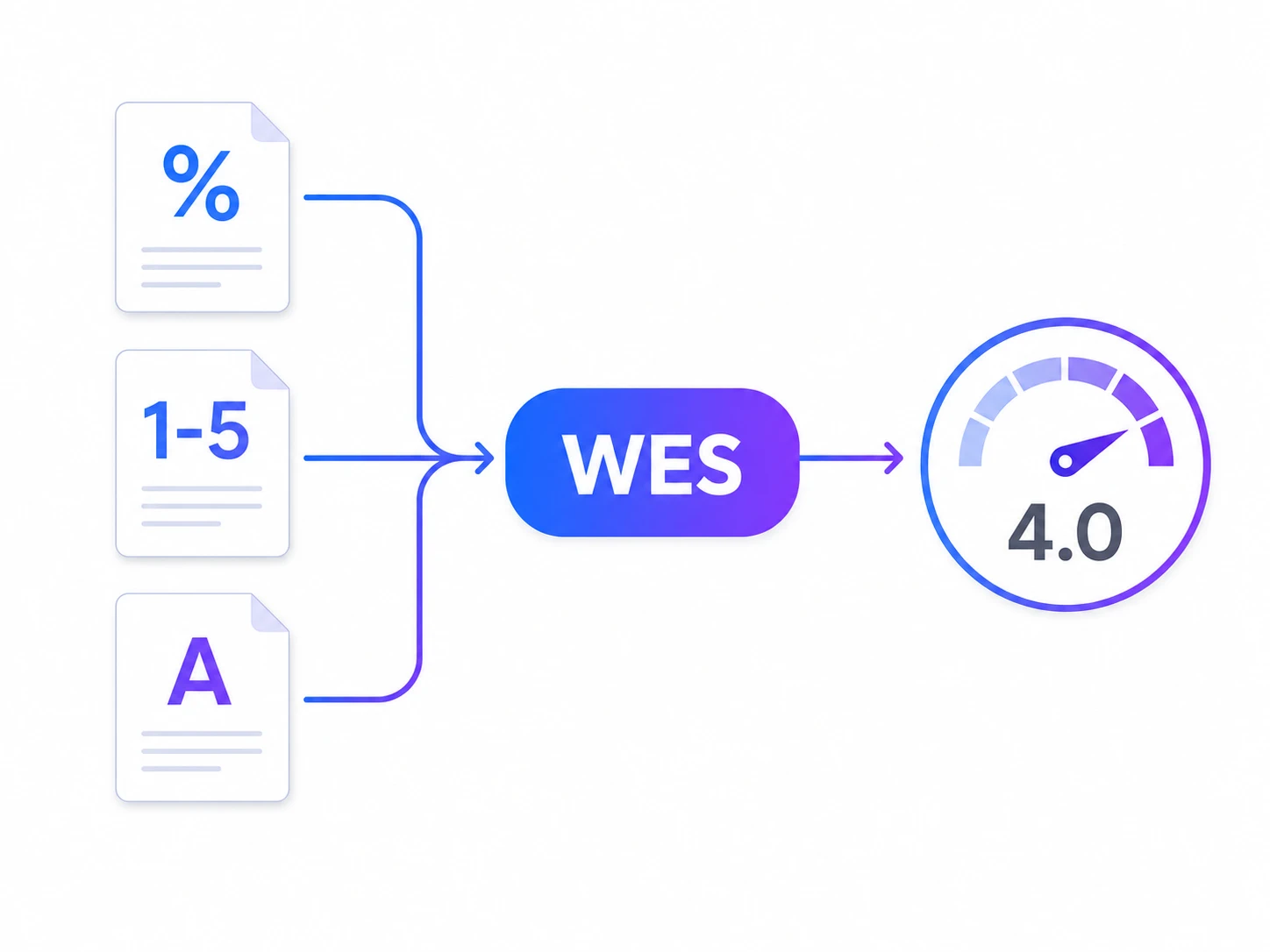
Grading differs wildly by country — a Chinese percentage, an Indian percentage, a German 1–5 scale. Admissions officers can neither read every system nor verify a transcript's authenticity. Evaluators like WES solve both: they authenticate documents (transcripts must come sealed or straight from the school) and convert your credentials, courses and grades into US / Canadian degree levels, credits and a GPA.
So a WES report is essentially a trusted translation plus an equivalency table. Many US and Canadian graduate schools, employers, and Canadian immigration (IRCC) require or accept it. Whether you need one — and which type — depends on what your target school or agency states on its application page.
Document-by-Document or Course-by-Course?
Choosing wrong means paying twice. The key difference in one line: only Course-by-Course includes a GPA and per-course analysis.
Document-by-Document (DxD)
Certifies which US / Canadian level your degree is equivalent to (e.g. "equivalent to a US bachelor's"), with no GPA and no course-level analysis. Common for employment and some immigration uses, and usually the cheapest of the three.
Course-by-Course (CxC, with GPA)
Everything in DxD plus each course's credits, grade and US equivalent, and a calculated overall GPA — the report grad applications most often require, and it costs more than DxD.
Basic or ICAP?
Basic is the report itself; ICAP (International Credential Advantage Package) adds secure storage plus sending your verified transcript directly to the schools you name — handy when applying to several schools or when a school requires a WES-delivered transcript.
The WES evaluation process in 5 steps
From order to report, the overall flow looks like this — the first two steps are your own ordering and document submission; the last three are WES's processing stages. The real time sink is getting documents delivered and accepted.
- 1
Create an order, choose the report type
Open a WES account, create an evaluation, pick your country, DxD / CxC, Basic / ICAP, and the schools to receive the report. WES then lists exactly which documents your country requires.
- 2
Submit — or have your school send — documents
Key rule: academic documents must generally arrive directly from the issuing institution, or sealed and stamped by it — you can't open them yourself. Students in China often use CHSI / CDGDC verified e-delivery.
- 3
WES receives and scans the documents
Once documents arrive, WES logs and scans each one and checks completeness. Missing items are flagged; evaluation won't start until the file is complete.
- 4
Authentication
WES verifies your transcripts with your institution or an official body — the reason its reports are so widely trusted.
- 5
Evaluate, then issue the report
Specialists apply your school's grading scale, compute the GPA, and after quality control issue the report — delivered to you and to the schools you named.
Which documents, and how to send transcripts that count
A WES report is trusted precisely because the documents were never in your hands. So sealed / direct delivery is non-negotiable.
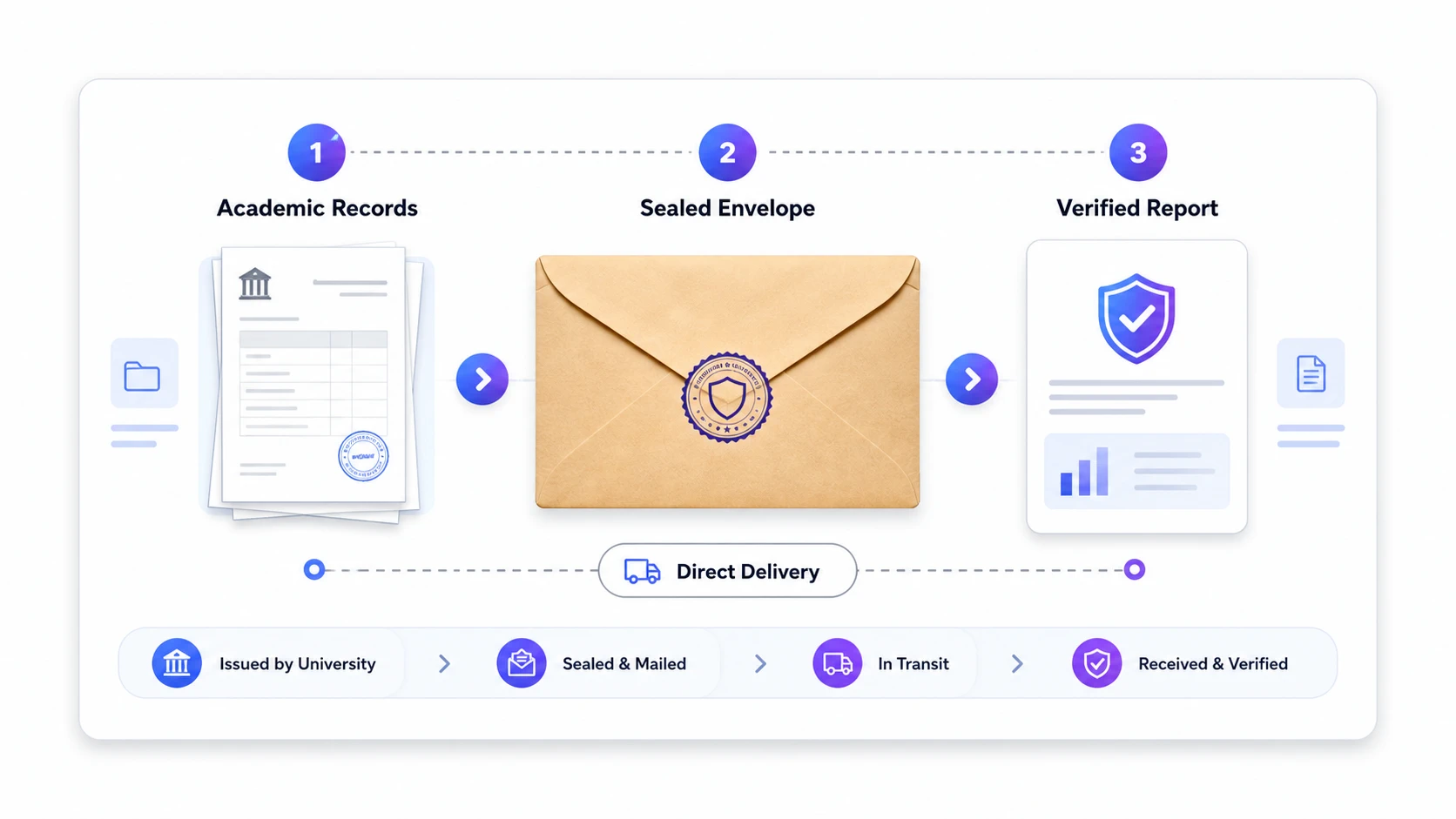
- 1
Your institution
issues the official transcript & degree
- 2
Sealed & stamped
stamped over the flap; void once opened
- 3
Sent straight to WES
the school sends it, not you
- Official transcript (all courses and grades)
- Degree / graduation certificate or proof of award
- School-sent or sealed & stamped: the flap is stamped by the school; once opened, it's void
- Non-English documents need a certified translation (in some countries done by WES or a named provider)
- Requirements vary by country — students in China usually use CHSI / CDGDC e-verification; check the WES list for your country first
How much, and how long
How the cost works
- Document-by-Document (equivalency only) is the cheapest
- Course-by-Course (with GPA) costs more than DxD
- ICAP costs more than Basic (adds verified transcript delivery)
- Plus a delivery fee based on copies and shipping method
Timeline
- The clock starts once documents are accepted: Document-by-Document takes about 1 week, Course-by-Course about 2 weeks (up to 4 for complex cases)
- Add document verification (typically about 2 weeks) plus mailing your documents and sending the report, and the end-to-end estimate is usually 4–7 weeks
- On a deadline? Order as soon as your documents are ready and leave a 4–7 week buffer
WES doesn't publish one fixed price: it varies by report type, number of copies and delivery method, and a full evaluation is typically in the low hundreds of USD. Figures change yearly — confirm on the current wes.org pricing page.
How WES turns grades into a US 4.0 GPA
Only the Course-by-Course report produces a GPA. WES converts course by course using your institution's own grading scale, then weights it — there is no single one-size-fits-all table; the widely quoted "85 = A = 4.0" is just a common simplification. Want a rough number first? Our calculator estimates a WES-style GPA (its US option treats 85 = A).
Estimate my WES-style GPA in the calculatorWES vs ECE, SpanTran and others
WES is among the most widely accepted evaluators, but not the only one — ECE, SpanTran and Scholaro also do equivalency evaluations. Which one counts is set by your target school or agency: some accept only WES, others accept several. Confirm on the application page before ordering, so you don't finish and find it isn't accepted.
WES
The most widely accepted; many North American grad schools, employers and Canadian immigration (IRCC) take it by default.
ECE
Another mainstream evaluator; some schools name it specifically or accept it alongside WES.
SpanTran
Also does course-by-course equivalency; certain schools or programs require it.
What matters isn't which is best, but which your target school accepts — always go by the application page.
Do you actually need a WES evaluation?
Simple test: only do it when a target school, employer or immigration authority explicitly asks for WES (or an equivalent) — and check whether they want DxD or CxC. Domestic Chinese grad admissions don't use it. If you do need it, order early once documents are ready and budget 4–7 weeks; incomplete documents are the biggest cause of delay.
Do WES if
- A target school, employer or immigration authority explicitly asks for WES or an equivalent
- You're applying to North American grad school and it requires Course-by-Course (courses + GPA)
- You need a trusted transcript equivalency and GPA others will accept
You can skip it if
- Domestic Chinese grad admissions — no third-party evaluation needed
- Your target school doesn't require any third-party equivalency
- You haven't fixed a direction yet — estimate your GPA first, then decide
Once you know your GPA, generate your own study-abroad report in minutes.
Generate my report freeEstimate your GPA before you pay to certify it
Most people get a WES evaluation to apply. Calculate your GPA and gauge your competitiveness first, then decide whether the evaluation is worth paying for.
Open the GPA calculatorCommon questions about WES
Do I always need a WES evaluation to apply?
No. Only when a target school, employer or immigration authority requires it. Many schools accept self-sent transcripts or other evaluators like ECE — check the application page first.
Should I pick DxD or CxC?
Pick Course-by-Course if you need a GPA or per-course analysis (typical for grad school); pick Document-by-Document if you only need degree equivalency (some jobs / immigration). Picking wrong means redoing it.
How long does WES take?
The clock starts once documents are accepted: DxD about 1 week, CxC about 2 weeks (up to 4 for complex cases); the verification stage typically adds about 2 weeks. With mailing and delivery, the end-to-end estimate is usually 4–7 weeks. On a deadline, start early and leave a buffer.
How much does WES cost?
WES doesn't publish one fixed price: it depends on report type, copies and delivery — Course-by-Course costs more than DxD, ICAP more than Basic, and a full evaluation is typically in the low hundreds of USD. Confirm the exact amount on wes.org.
How do I send transcripts so WES accepts them?
They generally must come directly from your institution, or sealed and stamped by it — you can't open them. Students in China often use CHSI / CDGDC verified e-delivery.
Is the GPA WES calculates accurate, and does it match mine?
WES converts course by course using your school's grading scale, so it won't match any fixed table exactly. Estimate it first with our calculator using the common WES basis (85 = A); the official number is whatever the WES report says.
Sources: WES official pages (wes.org) on the evaluation process, report types, document requirements and fees. WES.org ↗
Cost figures are WES's published pricing and timelines follow wes.org's current-processing page (some end-to-end durations are combined estimates); both can change yearly, and per-country document requirements are on the relevant page. This is an independent explainer, not affiliated with WES.